
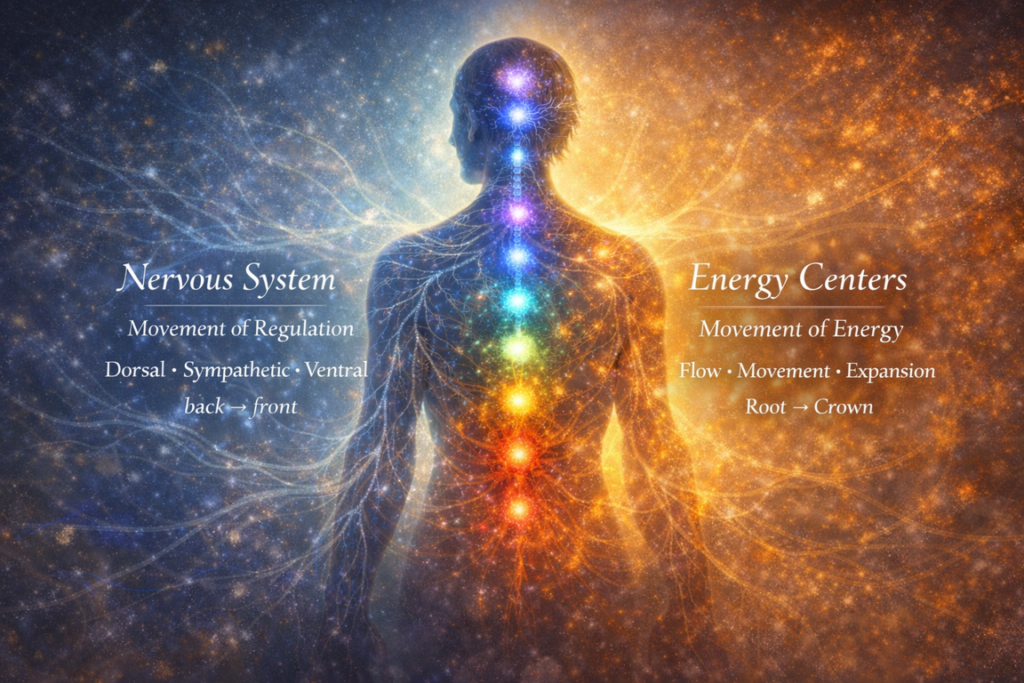
One describes the functions of the nervous system,
while the other describes the energetic movement of the body.
What if these two systems are not separate?
Two systems of the same living body.
One system, seen through two lenses.
Not as separate,
but as one unified system
working through different mechanisms.
One through the lens of energy.
The other through the lens of the nervous system.
When you start looking closely,
the connection between them becomes surprisingly clear.
A description often heard is:
my energy center — my chakra — is blocked.
But if we look closely at the nature of energy,
that idea becomes interesting.
Energy does not stop.
The body itself,
is living, moving energy.
Even what appears completely still
is still moving on a microscopic level.
Molecules vibrating.
Frequencies shifting.
Movement simply becoming slower, denser, less visible.
Even a block of ice is not truly still —
its molecules are vibrating, just very slowly.
So when we speak about energy centers in the body,
perhaps the question is not whether energy stops…
but how it moves.
Looking through the lens of the nervous system,
we describe something very similar.
We see a body that organizes itself,
in response to safety, threat, and connection.
Within this system we often speak about two main orientations:
the dorsal pathway
running along the back of the body, close to the spine,
and the ventral pathway
expressing more through the front of the body —
through breath, chest, voice and face.
These pathways describe very different states of being.
When the system moves toward dorsal shutdown,
the body tends to contract.
Movement slows.
Energy pulls inward.
The system conserves.
When the body moves toward ventral regulation,
something else becomes visible.
The chest softens.
Breath deepens.
The front of the body becomes available again.
Connection becomes possible.
And in these shifts of the body,
the two languages begin to meet.
This is where physiology and energy meet.
Perhaps it is not just the energy center that contracts or expands,
but the system itself responding.
Perhaps it is also the nervous system opening, mobilizing, pulling back.
Different words, but they describe the same movement.
Energy centers are often depicted
along the center of the body.
Whereas the nervous system organizes itself
between the front and the back of the body.
When the system moves into a dorsal state,
the body pulls inward.
Energy seems to retreat toward the spine.
The front of the body becomes quieter,
less available.
When the system moves into strong activation,
the front of the body can become almost overcharged —
too open, too mobilized.
But when the system settles into regulation,
there is a different quality.
Neither collapse nor overload.
Neither too open nor too closed.
Balanced.
Available.
Energy rests within the center.
Perhaps what we sometimes call
a “blocked” energy center
is not energy stopping at all.
It is the body holding energy
in the way it needs to survive.
When the nervous system finds safety again,
the movement returns.
Not because something mystical was forced open,
but because the system
no longer needs to hold it.
Seen from that perspective,
the languages of physiology and energy
are not separate explanations.
They are simply different ways
of describing the same living movement.
Two languages.
One body.
One movement of energy.